Wednesday, 6 November 2013

How to Write a Lesson Plan for Nigerian Teachers


lessonnote How to Write a Lesson Plan for Nigerian Teachers

How to Write a Lesson Plan

Lesson plan serves as a guide to teacher’s class objectives. It is much different from a lesson note, in that the lesson note is the knowledge you want to pass to the students while lesson plan is the steps you want to use in achieving the set goal and successfully impacting to the students a positive change.

It is much easier to accomplish your objectives if you have plan how to achieve them. It’s a very simple process and below you will find a step by step process. With a lesson plan template which can be found online you can just fill in the blank spaces.

On an average it will take between 1 – 4 hours to prepare a lesson plan.

Things You Will Need To Prepare a Lesson Plan

  • A paper or lesson planner
  • Pen
  • Textbooks
  • List of Available Lab Materials (if needed)

Steps to Planning a Lesson Plan


Outline Your Goals
Write down any goals you hope to achieve through the lesson, are there certain concepts you will be teaching? What do you want the students to gain by the end of the lesson?

Pick a Teaching Method
After deciding what to teach, now you select the teaching method that suits the subject/topic. It is going to be a lab exercise, lecture or demonstration? Will the students be in groups or individually?

Vocabulary Terms
Write down the list of vocabulary terms associated with your lesson and their meaning so you can teach the students as you go along.

Outline Your Teaching Steps and Materials
If you already have the materials to be used then this step is simple but if you haven’t develop them. List out your materials to be used and describe each step needed to complete the task. E.g. if you are teaching chemistry, make a list of the chemicals, instruments and how each task will be accomplish.

Make Your Introduction
The introduction to your lesson plan will include a statement of objectives, kind of assessment to be carried out, background information and procedure to be followed.

Assessment
Decide how to assess the students at the end of the lesson; will they have a take – home assignment, class work? How can the students practice what they have learnt and if you will be grading the lesson.

After Lesson
What will happen after the lesson, will the students have to clean up the lesson area, or they would have to complete a certain task before dispersing. Will you be giving them an assignment if yes, when will they have to turn it in. here it ends?

You have successfully created a lesson plan and the same method can be followed for any subject in any level. This lesson plan guides you all through so you don’t have to worry about what to do next during the lesson. Also another teacher can step in for you and do it well using your already created lesson plan. It makes the job easier.

Effective Classroom Management Principles


classboard Effective Classroom Management Principles

Classroom Management

Effective classroom management is an essential ingredients that promotes and enhances good study environment.
In the school system, it is not the headmaster or principal that manages the students. The teachers and other members of staff must cooperate to manage the classroom, children, resources and the environment.
Effective classroom management may include the use of;
Coercion through commands or punishment to get the children work together.
Teachers will need to understand the likes, dislikes and needs of each of the students in a given class.
Using rewards to motivate students into cooperating with their teachers
Also teachers can strive to create love and trust for their students, an attentive teacher will have a better shot at managing students.
The above in use, does not guarantee 100% cooperation but as time goes on, the students learn to understand their teacher, refrain from what they know their teacher dislikes or not to wait for instructions but do what they know their teacher would expect and this is the beginning of real discipline in the class.

Routine Classroom Management

One of the qualities of a good manager is that he does not try to do everything by himself but delegate’s responsibilities to his subjects, like a teacher.
In order to effectively manage a class, you ought to delegate daily routine operations to members of the class and request regular update and reports from them. ‘
Some of such routine operations in classroom management are: looking after the chalkboard, drinking water, notice board, attendance, pencils and rulers, collection and distribution of exercise books etc. All of these activities have to be assigned to specific student within a time frame.

Facilities Management

The class teacher will use facilities available to enhance teaching and learning in the classroom. Among these facilities are those that make the children comfortable such as chairs, desks, chalkboard and shelves where possessions of the students can be safely kept.
The desk should be 5 – 7 degrees so that the children do not have to bend their heads when writing more than is comfortable.
The desks should have compartments where children can keep away books which are needed during a particular lesson. The student should have access to the class timetable.
Chairs should be positioned in such a way, that students can sit with feet flatly on the floor and back resting on the back of the chair; such will reduce back pain, help them work for longer periods and support to the hands when writing.
In tropical countries such as ours, lightening can be too much especially if it comes from the wrong directions. E.g. the lightening from the sun may strike the chalkboard making it difficult for students in specific sides of the class to see the board clearly.
To avoid these, the teacher must close windows, put up curtains or erect adequate screens. Fluorescent lamps are much better than bulbs as they produce light similar to daylight at night.

Managing Ventilation in Classroom

Every effort must be made to provide adequate ventilation because its importance cannot be over emphasised. Lack of ventilation can cause tiredness and cause dullness and drowsiness in the class.
Yes it is important that students’ attention should be conformed to give rest and comfort to their eyes, so make windows low enough for them to see outside or they will look for reasons to go outside.
When planning a school, colour of classroom walls are often times over looked, many schools chose white walls, but white reflects a lot of light and makes the classroom too bright, this is too harsh especially in open countries and has psychological effects on the children, instead make use of lighter colours that moderates radiation and helps the children feel relaxed.
Chalkboard should be black, green or white; white chalks should go on black and green boards, teacher should write clearly and use rulers to draw straight lines.
Avoid using your hands to point to the board as it blocks students’ view, use pointers instead. A teacher must not talk to the board, read over what you have on the board and be sure of your facts to avoid misinforming the students.

Friday, 1 November 2013

MOMENTUM p = (Mass m X Speed s)


Momentum

The sports announcer says, "Going into the all-star break, the Chicago White Sox have the momentum." The headlines declare "Chicago Bulls Gaining Momentum." The coach pumps up his team at half-time, saying "You have the momentum; the critical need is that you use that momentum and bury them in this third quarter."
Momentum is a commonly used term in sports. A team that has the momentum is on the move and is going to take some effort to stop. A team that has a lot of momentum is really on the move and is going to be hard to stop. Momentum is a physics term; it refers to the quantity of motion that an object has. A sports team that is on the move has the momentum. If an object is in motion (on the move) then it has momentum.
Momentum can be defined as "mass in motion." All objects have mass; so if an object is moving, then it has momentum - it has its mass in motion. The amount of momentum that an object has is dependent upon two variables: how much stuff is moving and how fast the stuff is moving. Momentum depends upon the variables mass and velocity. In terms of an equation, the momentum of an object is equal to the mass of the object times the velocity of the object.

Momentum = mass • velocity

In physics, the symbol for the quantity momentum is the lower case "p". Thus, the above equation can be rewritten as

p = m • v

where m is the mass and v is the velocity. The equation illustrates that momentum is directly proportional to an object's mass and directly proportional to the object's velocity.
The units for momentum would be mass units times velocity units. The standard metric unit of momentum is the kg•m/s. While the kg•m/s is the standard metric unit of momentum, there are a variety of other units that are acceptable (though not conventional) units of momentum. Examples include kg•mi/hr, kg•km/hr, and g•cm/s. In each of these examples, a mass unit is multiplied by a velocity unit to provide a momentum unit. This is consistent with the equation for momentum.
Momentum is a vector quantity. As discussed in an earlier unit, a vector quantity is a quantity that is fully described by both magnitude and direction. To fully describe the momentum of a 5-kg bowling ball moving westward at 2 m/s, you must include information about both the magnitude and the direction of the bowling ball. It is not enough to say that the ball has 10 kg•m/s of momentum; the momentum of the ball is not fully described until information about its direction is given. The direction of the momentum vector is the same as the direction of the velocity of the ball. In a previous unit, it was said that the direction of the velocity vector is the same as the direction that an object is moving. If the bowling ball is moving westward, then its momentum can be fully described by saying that it is 10 kg•m/s, westward. As a vector quantity, the momentum of an object is fully described by both magnitude and direction.
From the definition of momentum, it becomes obvious that an object has a large momentum if either its mass or its velocity is large. Both variables are of equal importance in determining the momentum of an object. Consider a Mack truck and a roller skate moving down the street at the same speed. The considerably greater mass of the Mack truck gives it a considerably greater momentum. Yet if the Mack truck were at rest, then the momentum of the least massive roller skate would be the greatest. The momentum of any object that is at rest is 0. Objects at rest do not have momentum - they do not have any "mass in motion." Both variables - mass and velocity - are important in comparing the momentum of two objects.
The momentum equation can help us to think about how a change in one of the two variables might affect the momentum of an object. Consider a 0.5-kg physics cart loaded with one 0.5-kg brick and moving with a speed of 2.0 m/s. The total mass of loaded cart is 1.0 kg and its momentum is 2.0 kg•m/s. If the cart was instead loaded with three 0.5-kg bricks, then the total mass of the loaded cart would be 2.0 kg and its momentum would be 4.0 kg•m/s. A doubling of the mass results in a doubling of the momentum.
Similarly, if the 2.0-kg cart had a velocity of 8.0 m/s (instead of 2.0 m/s), then the cart would have a momentum of 16.0 kg•m/s (instead of 4.0 kg•m/s). A quadrupling in velocity results in a quadrupling of the momentum. These two examples illustrate how the equation p = m•v serves as a "guide to thinking" and not merely a "plug-and-chug recipe for algebraic problem-solving."


Check Your Understanding

Express your understanding of the concept and mathematics of momentum by answering the following questions. Click the button to view the answers.
1. Determine the momentum of a ...
a. 60-kg halfback moving eastward at 9 m/s. b. 1000-kg car moving northward at 20 m/s.
c. 40-kg freshman moving southward at 2 m/s.

Saturday, 26 October 2013

25 Public Speaking Skills Every Speaker Must Have


:
  1. Research a topic – Good speakers stick to what they know. Great speakers research what they need to convey their message.
  2. Focus – Help your audience grasp your message by focusing on your message. Stories, humour, or other “sidebars” should connect to the core idea. Anything that doesn’t needs to be edited out.
  3. Organize ideas logically – A well-organized presentation can be absorbed with minimal mental strain. Bridging is key.
  4. Employ quotations, facts, and statistics – Don’t include these for the sake of including them, but do use them appropriately to complement your ideas.
  5. Master metaphors – Metaphors enhance the understandability of the message in a way that direct language often can not.
  6. Tell a story – Everyone loves a story. Points wrapped up in a story are more memorable, too!
  7. Start strong and close stronger – The body of your presentation should be strong too, but your audience will remember your first and last words (if, indeed, they remember anything at all).
  8. Incorporate humour – Knowing when to use humour is essential. So is developing the comedic timing to deliver it with greatest effect.
  9. Vary vocal pace, tone, and volume – A monotone voice is like fingernails on the chalkboard.
  10. Punctuate words with gestures – Gestures should complement your words in harmony. Tell them how big the fish was, and show them with your arms.
  11. Utilize 3-dimensional space – Chaining yourself to the lectern limits the energy and passion you can exhibit. Lose the notes, and lose the chain.
  12. Complement words with visual aids – Visual aids should aid the message; they should not be the message. Read slide:ology or the Presentation Zen book and adopt the techniques.
  13. Analyze your audienceDeliver the message they want (or need) to hear.
  14. Connect with the audience – Eye contact is only the first step. Aim to have the audience conclude “This speaker is just like me!” The sooner, the better.
  15. Interact with the audience – Ask questions (and care about the answers). Solicit volunteers. Make your presentation a dialogue.
  16. Conduct a Q&A session – Not every speaking opportunity affords a Q&A session, but understand how to lead one productively. Use the Q&A to solidify the impression that you are an expert, not (just) a speaker.
  17. Lead a discussion – Again, not every speaking opportunity affords time for a discussion, but know how to engage the audience productively.
  18. Obey time constraints – Maybe you have 2 minutes. Maybe you have 45. Either way, customize your presentation to fit the time allowed, and respect your audience by not going over time.
  19. Craft an introduction – Set the context and make sure the audience is ready to go, whether the introduction is for you or for someone else.
  20. Exhibit confidence and poise – These qualities are sometimes difficult for a speaker to attain, but easy for an audience to sense.
  21. Handle unexpected issues smoothly – Maybe the lights will go out. Maybe the projector is dead. Have a plan to handle every situation.
  22. Be coherent when speaking off the cuff – Impromptu speaking (before, after, or during a presentation) leaves a lasting impression too. Doing it well tells the audience that you are personable, and that you are an expert who knows their stuff beyond the slides and prepared speech.
  23. Seek and utilize feedback – Understand that no presentation or presenter (yes, even you!) is perfect. Aim for continuous improvement, and understand that the best way to improve is to solicit candid feedback from as many people as you can.
  24. Listen critically and analyze other speakers – Study the strengths and weakness of other speakers.
  25. Act and speak ethically – Since public speaking fears are so common, realize the tremendous power of influence that you hold. Use this power responsibly.

3 Keys to Public Speaking

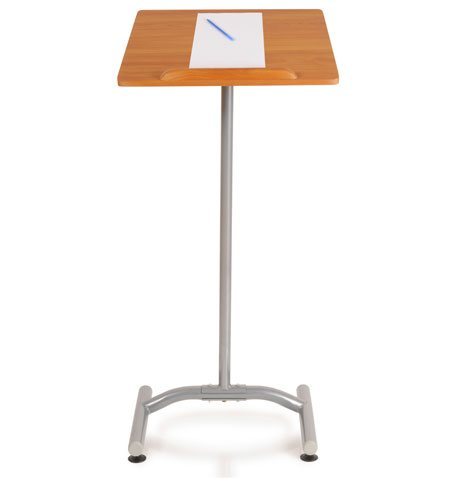
Podium
Whether you are addressing a small group or find yourself behind a podium in front of hundreds, public speaking can be unnerving and downright frightening to some, while seemingly innocuous to others.
So what separates the two mindsets? Mainly, those who struggle with public speaking do so because it is outside of their comfort zone, they lack confidence, or they exhibit a disdain for the practice altogether. For many engineers, public speaking is outside of their comfort zone.
There are many reasons why public speaking skills will help in the professional world. For example, often you work in a small project group. You may have the best idea, or the best approach to solving the problem, but if you can’t communicate it better than the other team members, your idea will not be heard.
You may be asked to work in your company’s trade show booth, where you need to present the features and benefits of the company’s products to prospective customers. You may be asked (or told) to present a technical paper at an industry conference of your peers. Or, you may one day become an entrepreneur, where you will find yourself presenting your business plan to a group of potential investors. In any case, you need to communicate effectively to achieve your goals.
Follow the 3 P’s to Success
For most people, public speaking does not come naturally. Good speakers are made, not born. Even those who seem to be naturally gifted speakers follow these simple rules of thumb: Prepare, Practice, and Personalize.
1. Prepare
How long will you be speaking, five minutes or an hour? Who is the audience? What is the venue —a staff meeting or a large group? With that in mind, you need to prepare and organize your thoughts. It is important that you thoroughly understand your topic and what you plan to present. Prepare your presentation with the audience in mind. What are you trying to communicate and what is the desired outcome? Once you have a clear objective, be sure that your speaking points succinctly support your objective. Don’t cloud the presentation with too much information. Finally, anticipate questions and prepare answers.
2. Practice
Practice your presentation out loud. As odd as this may sound, it is important that you get used to the sound of your own voice. Are there words or phrases you want to emphasize by changing your inflection? Practice it.  Even the public speakers who seem the most natural practice.
3. Personalize
By personalize I mean be yourself. If you are outgoing and have a great sense of humor, use it to your advantage during your presentation. Be yourself. If you are not outwardly demonstrative or emotional, don’t try to be so during your presentation—you won’t be able to pull it off. Just be yourself.  I recently attended a breakfast meeting at which the CEO of a large company was the keynote speaker. In his introductory remarks, he came across as knowledgeable and personable with a great sense of humor. However, once he began his formal presentation, he read from a script (perhaps someone prepared it for him) and came across as dry, humorless, and uninteresting. He wasn’t being himself. 
Anyone can turn themselves into a great public speaker. It just takes preparation, practice and a bit of personality

CLASSROOM MANAGEMENT


Classroom Management, Management of Student Conduct, Effective Praise Guidelines, and a Few
Dr. Bob Kizlik
The evidence is irrefutable, Surveys of graduates of education schools and colleges indicate that the #1 area of concern of new teachers is their feelings of inadequacy in managing classrooms. Despite clinical experiences, practicums, student teaching, and other observations in classroom settings, this problem has persisted for decades. There is no magic elixir that will confer skill in this area of professional responsibility. We only wish there were.
Classroom management and management of student conduct are skills that teachers acquire and hone over time. These skills almost never "jell" until after a minimum of few years of teaching experience. To be sure, effective teaching requires considerable skill in managing the myriad of tasks and situations that occur in the classroom each day. Skills such as effective classroom management are central to teaching and require "common sense," consistency, a sense of fairness, and courage. These skills also require that teachers understand in more than one way the psychological and developmental levels of their students. The skills associated with effective classroom management are only acquired with practice, feedback, and a willingness to learn from mistakes. Sadly, this is often easier said than done. Certainly, a part of this problem is that there is no practical way for education students to "practice" their nascent skills outside of actually going into a classroom setting. The learning curve is steep, indeed.
As previously mentioned, personal experience and research indicate that many beginning teachers have difficulty effectively managing their classrooms. While there is no one best solution for every problem or classroom setting, the following principles, drawn from a number of sources, might help. Classroom teachers with many years of experience have contributed to an understanding of what works and what doesn't work in managing classrooms and the behavior of students. The following information represents some of the things that good classroom teachers do to maintain an atmosphere that enhances learning. It is written in straightforward, non-preachy language, and will not drive you to distraction with its length. I think most students appreciate that. With that in mind, I truly hope this information is useful to you.
Please send any comments, suggestions, or questions to Dr. Robert Kizlik
WB00795_.gif (408 bytes)
An Effective Classroom Management Context
(these four things are fundamental)
1. Know what you want and what you don't want.
2. Show and tell your students what you want.
3. When you get what you want, acknowledge (not praise) it.
4. When you get something else, act quickly and appropriately.
WB00795_.gif (408 bytes)
CLASSROOM ARRANGEMENT
While good classroom arrangement is not a guarantee of good behavior, poor planning in this area can create conditions that lead to problems.
 
The teacher must be able to observe all students at all times and to monitor work and behavior. The teacher should also be able to see the door from his or her desk.
Frequently used areas of the room and traffic lanes should be unobstructed and easily accessible.
Students should be able to see the teacher and presentation area without undue turning or movement.
Commonly used classroom materials, e.g., books, attendance pads, absence permits, and student reference materials should be readily available.
Some degree of decoration will help add to the attractiveness of the room.
SETTING EXPECTATIONS FOR BEHAVIOR
*Teachers should identify expectations for student behavior and communicate those expectations to students periodically.
* Rules and procedures are the most common explicit expectations. A small number of general rules that emphasize appropriate behavior may be helpful. Rules should be posted in the classroom. Compliance with the rules should be monitored constantly.
* Do not develop classroom rules you are unwilling to enforce.
* School-Wide Regulations...particularly safety procedures...should be explained carefully.
* Because desirable student behavior may vary depending on the activity, explicit expectations for the following procedures are helpful in creating a smoothly functioning classroom:
- Beginning and ending the period, including attendance procedures and what students may or may not do during these times.
- Use of materials and equipment such as the pencil sharpener, storage areas, supplies, and special equipment.
- Teacher-Led Instruction
- Seatwork
- How students are to answer questions - for example, no student answer will be recognized unless he raises his hand and is called upon to answer by the teacher.
- Independent group work such as laboratory activities or smaller group projects.
Remember, good discipline is much more likely to occur if the classroom setting and activities are structured or arranged to enhance cooperative behavior.
MANAGING STUDENT ACADEMIC WORK
* Effective teacher-led instruction is free of:
- Ambiguous and vague terms
- Unclear sequencing
- Interruptions
* Students must be held accountable for their work.
* The focus is on academic tasks and learning as the central purpose of student effort, rather than on good behavior for its own sake.
MANAGING INAPPROPRIATE BEHAVIOR
* Address instruction and assignments to challenge academic achievement while continuing to assure individual student success.
* Most inappropriate behavior in classrooms that is not seriously disruptive and can be managed by relatively simple procedures that prevent escalation.
* Effective classroom managers practice skills that minimize misbehavior.
* Monitor students carefully and frequently so that misbehavior is detected early before it involves many students or becomes a serious disruption.
* Act to stop inappropriate behavior so as not to interrupt the instructional activity or to call excessive attention to the student by practicing the following unobstructive strategies:
- Moving close to the offending student or students, making eye contact and giving a nonverbal signal to stop the offensive behavior.
- Calling a student's name or giving a short verbal instruction to stop behavior.
- Redirecting the student to appropriate behavior by stating what the student should be doing; citing the applicable procedure or rule.
Example: "Please, look at the overhead projector and read the first line with me, I need to see everyone's eyes looking here."
- More serious, disruptive behaviors such as fighting, continuous interruption of lessons, possession of drugs and stealing require direct action according to school board rule.
Assertive Discipline has been used by many schools, and is an effective way to manage behavior. Find out more by clicking here.
PROMOTING APPROPRIATE USE OF CONSEQUENCES
* In classrooms, the most prevalent positive consequences are intrinsic student satisfaction resulting from success, accomplishment, good grades, social approval and recognition.
* Students must be aware of the connection between tasks and grades.
* Frequent use of punishment is associated with poor classroom management and generally should be avoided.
* When used, negative consequences or punishment should be related logically to the misbehavior.
* Milder punishments are often as effective as more intense forms and do not arouse as much negative emotion.
* Misbehavior is less likely to recur if a student makes a commitment to avoid the action and to engage in more desirable alternative behaviors.
* Consistency in the application of consequences is the key factor in classroom management.
SOME ESOL PRINCIPLES
(A FEW THINGS TO KNOW ABOUT L.E.P. STUDENTS):
* They are not stupid and they can hear what is being said.. They just don't necessarily understand the language or culture, yet.
* They come from a variety of backgrounds, even in the same country. For example schooled, unschooled, Americanized, etc.
* It is easy to misunderstand body language and certain behaviors. For example, eye contact, spitting, chalk eating, etc.
* Don't assume they understand something just because it seems simple to you. Simplify, boil down.
* Even when they have lost their accent, they often misunderstand common words and phrases.
* Correct repeated patterns or mistakes.
* Good E.S.O.L. strategies are good teaching strategies.
GUIDELINES FOR EFFECTIVE PRAISE
(Applies primarily to praise associated with instruction and student performance)
Effective Praise
Ineffective Praise
1. Is delivered contingently upon student
performance of desirable behaviors or
genuine accomplishment
1. Is delivered randomly and indiscriminately without specific attention to genuine accomplishment
2. Specifies the praiseworthy aspects of the student's accomplishments
2. Is general or global, not specifying the success.
3. Is expressed sincerely, showing spontaneity, variety and other non-verbal signs of credibility.
3. Is expressed blandly without feeling or animation, and relying on stock, perfunctory phrases.
4. Is given for genuine effort, progress, or accomplishment which are judged according to standards appropriate to individuals.
4. Is given based on comparisons with others and without regard to the effort expended or significance of the accomplishment of an individual.
5. Provides information to students about their competence or the value of their accomplishments.
5. Provides no meaningful information to the students about their accomplishments.
6. Helps students to better appreciate their thinking, problem-solving and performance.
6. Orients students toward comparing themselves with others.
7. Attributes student success to effort and ability, implying that similar successes can be expected in the future.
7. Attributes student success to ability alone or to external factors such as luck or easy task.
8. Encourages students to appreciate their accomplishments for the effort they expend and their personal gratification.
8. Encourages students to succeed for external reasons -- to please the teacher, win a competition or reward, etc.

Classroom management

Classroom management is a term used by teachers to describe the process of ensuring that classroom lessons run smoothly despite disruptive behavior by students. The term also implies the prevention of disruptive behavior. It is possibly the most difficult aspect of teaching for many teachers; indeed experiencing problems in this area causes some to leave teaching altogether. In 1981 the US National Educational Association reported that 36% of teachers said they would probably not go into teaching if they had to decide again. A major reason was "negative student attitudes and discipline".[1]
According to Moskowitz & Hayman (1976), once a teacher loses control of their classroom, it becomes increasingly more difficult for them to regain that control.[2] Also, research from Berliner (1988) and Brophy & Good (1986) shows that the time a teacher has to take to correct misbehavior caused by poor classroom management skills results in a lower rate of academic engagement in the classroom.[3] From the student’s perspective, effective classroom management involves clear communication of behavioral and academic expectations as well as a cooperative learning environment.[4]
Classroom management is closely linked to issues of motivation, discipline and respect. Methodologies remain a matter of passionate debate amongst teachers; approaches vary depending on the beliefs a teacher holds regarding educational psychology. A large part of traditional classroom management involves behavior modification, although many teachers see using behavioral approaches alone as overly simplistic. Many teachers establish rules and procedures at the beginning of the school year. According to Gootman (2008), rules give students concrete direction to ensure that our expectation becomes a reality.[5]
They also try to be consistent in enforcing these rules and procedures. Many would also argue for positive consequences when rules are followed, and negative consequences when rules are broken. There are newer perspectives on classroom management that attempt to be holistic. One example is affirmation teaching, which attempts to guide students toward success by helping them see how their effort pays off in the classroom. It relies upon creating an environment where students are successful as a result of their own efforts.[6] By creating this type of environment, students are much more likely to want to do well. Ideally, this transforms a classroom into a community of well-behaved and self-directed learners.

Techniques

Corporal punishment
Until recently, corporal punishment was widely used as a means of controlling disruptive behavior but it is now no longer fashionable, though it is still advocated in some contexts by people such as James Dobson.
Rote discipline
Also known as "lines," rote discipline is a negative sanction used for behavior management. It involves assigning a disorderly student sentences or the classroom rules to write repeatedly. Among the many types of classroom management approaches, it is very commonly used.
Preventative techniques
Preventative approaches to classroom management involve creating a positive classroom community with mutual respect between teacher and student. Teachers using the preventative approach offer warmth, acceptance, and support unconditionally - not based on a student’s behavior. Fair rules and consequences are established and students are given frequent and consistent feedback regarding their behavior.[7] One way to establish this kind of classroom environment is through the development and use of a classroom contract. The contract should be created by both students and the teacher. In the contract, students and teachers decide and agree on how to treat one another in the classroom. The group also decides on and agrees to what the group will do should there be a violation of the contract. Rather than a consequence, the group should decide on a way to fix the problem through either class discussion, peer mediation, counseling, or by one on one conversations leading to a solution to the situation.
Preventative techniques also involve the strategic use of praise and rewards to inform students about their behavior rather than as a means of controlling student behavior. In order to use rewards to inform students about their behavior, teachers must emphasize the value of the behavior that is rewarded and also explain to students the specific skills they demonstrated to earn the reward. Teachers should also encourage student collaboration in selecting rewards and defining appropriate behaviors that will earn rewards.[8]

Systematic Approaches

The Good Behavior Game

The Good Behavior Game (GBG) is a "classroom-level approach to behavior management" [9] that was originally used in 1969 by Barrish, Saunders, and Wolf. The Game entails the class earning access to a reward or losing a reward, given that all members of the class engage in some type of behavior (or did not exceed a certain amount of undesired behavior). The GBG can be used to increase desired behaviors (e.g., question asking) or to decrease undesired behaviors (e.g., out of seat behavior). The GBG has been used with preschoolers as well as adolescents, however most applications have been used with typically developing students (i.e., those without developmental disabilities). In addition, the Game "is usually popular with and acceptable to students and teachers."[10]

Discipline with Dignity

According to its founders, Discipline with Dignity is one of the most widely practiced behavior management philosophies in the world. Founded by Dr. Richard Curwin and Dr. Allen Mendler, the program is utilized in more than 12 different countries. Discipline with Dignity provides an in-depth flexible approach for effective school and classroom management. With a strong focus on developing responsibility, it is a comprehensive, practical program that leads to improved student behavior through responsible thinking, cooperation, mutual respect, and shared decision-making.

Tools for Teaching

Tools for Teaching is a classroom management method created and taught by Fred Jones on speaking tours and in the eponymous book series

Positive Classrooms

Positive Classrooms developed by Dr. Robert DiGiulio sees positive classroom management as the result of four factors: how teachers regard their students (spiritual dimension), how they set up the classroom environment (physical dimension), how skillfully they teach content (instructional dimension), and how well they address student behavior (managerial dimension).

Assertive Discipline

Assertive discipline is another systematic approach of classroom management. Lee and Marlene Canter discuss the ideas behind this approach in several published books.

Discipline without Stress, Punishments or Rewards

Discipline without Stress (or DWS) is a K-12 discipline and learning approach developed by Dr. Marvin Marshall described in his 2001 book, Discipline without Stress, Punishments or Rewards.[11] The approach is designed to educate young people about the value of internal motivation. The intention is to prompt and develop within youth a desire to become responsible and self-disciplined and to put forth effort to learn. The most significant characteristics of DWS are that it is totally noncoercive (but not permissive) and takes the opposite approach to Skinnerian behaviorism that relies on external sources for reinforcement.

Classroom management as a process

In the Handbook of Classroom Management: Research Practice and Contemporary Issues (2006),[12] Evertson and Weinstein characterize classroom management as the actions taken to create an environment that supports and facilitates academic and social–emotional learning. Toward this goal, teachers must (1) develop caring, supportive relationships with and among students; (2) organize and implement instruction in ways that optimize students’ access to learning; (3) use group management methods that encourage students’ engagement in academic tasks; (4) promote the development of students’ social skills and self–regulation; and (5) use appropriate interventions to assist students with behavior problems.
Dr. Tracey Garrett also describes classroom management as a process consisting of key tasks that teachers must attend to in order to development an environment conducive to learning. These tasks include: (1) organizing the physical environment, (2) establishing rules and routines, (3) developing caring relationships, (4) implementing engaging instruction and (5) preventing and responding to discipline problems. Classroom Management Essentials, created by Dr. Tracey Garrett, is the first classroom management app for the iPad, iPhone and iPod touch that guides teachers through the tasks involved in the process of classroom management.

Classroom management as time management

In their introductory text on teaching, Kauchak and Eggen (2008)Kauchak, D., and Eggen, P. (2008). Introduction to teaching: Becoming a professional (3rd ed.). Upper Saddle River, NJ: Pearson Education, Inc. explain classroom management in terms of time management. The goal of classroom management, to Kauchak and Eggen, is to not only maintain order but to optimize student learning. They divide class time into four overlapping categories, namely allocated time, instructional time, engaged time, and academic learning time.
Allocated time
Allocated time is the total time allotted for teaching, learning, and routine classroom procedures like attendance and announcements. Allocated time is also what appears on a student's schedule, for example "Introductory Algebra: 9:50-10:30 a.m." or "Fine Arts 1:15-2:00 p.m."
Instructional time
Instructional time is what remains after routine classroom procedures are completed. That is to say, instructional time is the time wherein teaching and learning actually takes place. Teachers may spend two or three minutes taking attendance, for example, before their instruction begins.
Engaged time
Engaged time is also called time on task. During engaged time, students are participating actively in learning activities—asking and responding to questions, completing worksheets and exercises, preparing skits and presentations, etc.
Academic learning time
Academic learning time occurs when students 1) participate actively and 2) are successful in learning activities. Effective classroom management maximizes academic learning time.

Common mistakes in classroom behavior management

In an effort to maintain order in the classroom, sometimes teachers can actually make the problems worse. Therefore, it is important to consider some of the basic mistakes commonly made when implementing classroom behavior management strategies. For example, a common mistake made by teachers is to define the problem behavior by how it looks without considering its function.[13]
Interventions are more likely to be effective when they are individualized to address the specific function of the problem behavior. Two students with similar looking misbehavior may require entirely different intervention strategies if the behaviors are serving different functions. Teachers need to understand that they need to be able to change the ways they do things from year to year, as the children change. Not every approach works for every child. Teachers need to learn to be flexible. Another common mistake is for the teacher to become increasingly frustrated and negative when an approach is not working.[13]
The teacher may raise his or her voice or increase adverse consequences in an effort to make the approach work. This type of interaction may impair the teacher-student relationship. Instead of allowing this to happen, it is often better to simply try a new approach.
Inconsistency in expectations and consequences is an additional mistake that can lead to dysfunction in the classroom.[13] Teachers must be consistent in their expectations and consequences to help ensure that students understand that rules will be enforced. To avoid this, teachers should communicate expectations to students clearly and be sufficiently committed to the classroom management procedures to enforce them consistently.

150 Teaching Methods

  1. Lecture by teacher (and what else can you do!)
  2. Class discussion conducted by teacher (and what else!)
  3. Recitation oral questions by teacher answered orally by students (then what!)
  4. Discussion groups conducted by selected student chairpersons (yes, and what else!)
  5. Lecture-demonstration by teacher (and then what 145 other techniques!)
  6. Lecture-demonstration by another instructor(s) from a special field (guest speaker)
  7. Presentation by a panel of instructors or students
  8. Presentations by student panels from the class: class invited to participate
  9. Student reports by individuals
  10. Student-group reports by committees from the class
  11. Debate (informal) on current issues by students from class
  12. Class discussions conducted by a student or student committee
  13. Forums
  14. Bulletin boards
  15. Small groups such as task oriented, discussion, Socratic
  16. Choral speaking
  17. Collecting
  18. Textbook assignments
  19. Reading assignments in journals, monographs, etc.
  20. Reading assignments in supplementary books
  21. Assignment to outline portions of the textbook
  22. Assignment to outline certain supplementary readings
  23. Debates (formal)
  24. Crossword puzzles
  25. Cooking foods of places studied
  26. Construction of vocabulary lists
  27. Vocabulary drills
  28. Diaries
  29. Dances of places or periods studied
  30. Construction of summaries by students
  31. Dressing dolls
  32. Required term paper
  33. Panel discussion
  34. Biographical reports given by students
  35. Reports on published research studies and experiments by students
  36. Library research on topics or problems
  37. Written book reports by students
  38. Flags
  39. Jigsaw puzzle maps
  40. Hall of Fame by topic or era (military or political leaders, heroes)
  41. Flannel boards
  42. Use of pretest
  43. Gaming and simulation
  44. Flash cards
  45. Flowcharts
  46. Interviews
  47. Maps, transparencies, globes
  48. Mobiles
  49. Audio-tutorial lessons (individualized instruction)
  50. Models
  51. Music
  52. Field trips
  53. Drama, role playing
  54. Open textbook study
  55. Committee projects--small groups
  56. Notebook
  57. Murals and montages
  58. Class projects
  59. Individual projects
  60. Quizdown gaming
  61. Modeling in various media
  62. Pen pals
  63. Photographs
  64. Laboratory experiments performed by more than two students working together
  65. Use of dramatization, skits, plays
  66. Student construction of diagrams, charts, or graphs
  67. Making of posters by students
  68. Students drawing pictures or cartoons vividly portray principles or facts
  69. Problem solving or case studies
  70. Puppets
  71. Use of chalkboard by instructor as aid in teaching
  72. Use of diagrams, tables, graphs, and charts by instructor in teaching
  73. Use of exhibits and displays by instructor
  74. Reproductions
  75. Construction of exhibits and displays by students
  76. Use of slides
  77. Use of filmstrips
  78. Use of motion pictures, educational films, videotapes
  79. Use of theater motion pictures
  80. Use of recordings
  81. Use of radio programs
  82. Use of television
  83. Role playing
  84. Sand tables
  85. School affiliations
  86. Verbal illustrations: use of anecdotes and parables to illustrate
  87. Service projects
  88. Stamps, coins, and other hobbies
  89. Use of community or local resources
  90. Story telling
  91. Surveys
  92. Tutorial: students assigned to other students for assistance, peer teaching
  93. Coaching: special assistance provided for students having difficulty in the course
  94. Oral reports
  95. Word association activity
  96. Workbooks
  97. Using case studies reported in literature to illustrate psychological principles and facts
  98. Construction of scrapbooks
  99. Applying simple statistical techniques to class data
  100. Time lines
  101. "Group dynamics" techniques
  102. Units of instruction organized by topics
  103. Non directive techniques applied to the classroom
  104. Supervised study during class period
  105. Use of sociometric text to make sociometric analysis of class
  106. Use of technology and instructional resources
  107. Open textbook tests, take home tests
  108. Put idea into picture
  109. Write a caption for chart, picture, or cartoon
  110. Reading aloud
  111. Differentiated assignment and homework
  112. Telling about a trip
  113. Mock convention
  114. Filling out forms (income tax, checks)
  115. Prepare editorial for school paper
  116. Attend council meeting, school boar meeting
  117. Exchanging "things"
  118. Making announcements
  119. Taking part (community elections)
  120. Playing music from other countries or times
  121. Studying local history
  122. Compile list of older citizens as resource people
  123. Students from abroad (exchange students)
  124. Obtain free and low cost materials
  125. Collect old magazines
  126. Collect colored slides
  127. Visit an "ethnic" restaurant
  128. Specialize in one country
  129. Follow a world leader (in the media)
  130. Visit an employment agency
  131. Start a campaign
  132. Conduct a series
  133. Investigate a life
  134. Assist an immigrant
  135. Volunteer (tutoring, hospital)
  136. Prepare an exhibit
  137. Detect propaganda
  138. Join an organization
  139. Collect money for a cause
  140. Elect a "Hall of Fame" for males
  141. Elect a "Hall of Fame" for females
  142. Construct a salt map
  143. Construct a drama
  144. Prepare presentation for senior citizen group
  145. Invite senior citizen(s) to present local history to class including displaying artifacts (clothing, tools, objects, etc.)
  146. Prepare mock newspaper on specific topic or era
  147. Draw a giant map on floor of classroom
  148. Research local archaeological site
  149. Exchange program with schools from different parts of the state
  150. In brainstorming small group, students identify a list of techniques and strategies that best fit their class.

3 New Teaching Methods Improve the Educational Process


By Sonia Jackson
The traditional “chalk and talk” method of teaching that’s persisted for hundreds of years is now acquiring inferior results when compared with the more modern and revolutionary teaching methods that are available for use in schools today. Greater student interaction is encouraged, the boundaries of authority are being broken down, and a focus on enjoyment over grades is emphasised.
As teachers, it’s necessary to be able to teach and remain engaging. It puts a greater level of responsibility on creating lesson plans that truly work. Here are three teaching methods that are making an impact.

Spaced Learning

Teachers have reported amazing results when it came to spaced learning. Spaced Learning is a learning method in which the condensed learning content is repeated three times, with two 10-minute breaks during which activities such as physical activities are performed by the students – I think, that PE and lessons can be combined.
Spaced learning involves encouraging students to quickly switch through activities. For example, providing ten minutes of knowledge on the nervous system with a PowerPoint presentation and then having 15 minutes of basketball would be the way to get the better grades.
The results don’t lie and the creators of the system at Monkseaton High School in Tyne and Wear have reported that it does work. They claim that it’s more effective than simply teaching students by utilising traditional methods for four hours.
The key is in the brain cells. It helps them to create the connections that they need to actually remember the knowledge. Furthermore, it has the additional benefit of allowing people to relax. If they are compressing sections of the syllabus into such small sections then there’s no time to worry. It’s all about the learning before moving on to another session of activity.

Flexible Fridays

Sometimes conventional lesson blocks just don’t work as every student is different and they all have their problematic subjects. The concept of Flexible Fridays is that an in-depth session of a subject can be acquired by simply having a whole day of mathematics or some other subject.
At Flexible Fridays lessons a teacher try to help each student to study and learn what is the most difficult for him/her personally. Somebody repeats, somebody learns. It makes it more convenient for students as now they can focus on one thing while in school. It means that students don’t have a breaking point by spending hours struggling with a subject along at home.
Teachers also find it easier as they can keep their lesson plans and simply go over them again with a more personal touch. Flexible Friday lessons are more in-touch with students and gives focused study time that can help students grasp difficult concepts.
Teachers are also able to aid students by simply having fast-track weeks. Having a whole week of mathematics or English can help students to get through the subjects in a shorter amount of time.
It’s good news for teachers and students alike because even though a lesson lasts an hour it could actually lose up to 25 percent of its designated time. There’s the preparing for class and packing away to take into account, and students are not always the quickest at performing these tasks.
Teacher should choose what method is more appropriate for his/her students: spaced learning or Flexible Fridays.

Engagement

Under a new teaching method called “engagement” students are urged to engage with the real world, analyse everything that happens in different life spheres (not only internship but also economical, business, social spheres, etc.). Business studies are where this new focus of engagement occurred at the Leasowes Community College in Dudley.
Instead of conventional teaching methods, students were taken to visit local businesses where they were able to witness how the knowledge that they were learning applied to the real world.
Multiple days were set aside for this practice and all students were required to wear business suits in order to attend. The idea is to get students engaged and to connect their learning to the real world. If teachers can show them how what they are teaching connects to the real world then their own brain cells are going to connect them and associate them.
The results are there for all to see because before this new method was introduced only 40 percent of students achieved grades of A-C across both years 10 and 11. Under the new teaching method the institution reported that the numbers had shot up to a massive 91 percent of students achieving A-Cs in years 10 and year 11.
New methods of teaching have the purpose to improve the quality of education and involve students in educational process. Innovations mean a progress and development.

THE MIRACLE OF SELF DISCIPLINE - BRIAN TRACY


Your ability to develop the habit of self-discipline will contribute more to your success than any other

quality of character.

Some years ago, I met Kop Kopmeyer, a noted success authority who had discovered one thousand suc-
cess principles which he had published in four books containing 250 principles each.

I asked him which of these one thousand principles he considered to be the most important. He said that

it was self-discipline, “The ability to make yourself do, what you should do, when you should do it, whether

you feel like it or not.”

Napoleon Hill, after interviewing 500 of the richest people in Amer-
ica, concluded that “Self-discipline is the master key to riches.”

Tom ----- the famous sales trainer, said that “Success is tons of

discipline.”

Jim Rollins said, “Discipline weighs ounces, but regret weights

tons.”

Dr. Edward Banfield from Harvard concluded that “Long time perspective” was the key to upward social

and economic mobility in America or anywhere else in the world.

He discovered in fifty years of research, that people who succeeded greatly had the ability to think long

term, to delay gratification in the short term so that they could enjoy even greater rewards in the long

term. They thought ten and twenty years into the future while making decisions for their current actions.

The key word is “sacrifice.” It is the ability for you to sacrifice immediate pleasure or gratification in the

present so that you can enjoy greater rewards down the road.

Albert Einstein once said that, “Compound interest is the most powerful force in the universe.” This is why

saving and investing in the present is the first key to becoming financially successful in the future.

Self-discipline means self-control, self-mastery, and the ability to have “dinner before dessert.”

This doesn’t mean that you don’t have pleasurable experiences in life, but it means that you have them

after you have done the hard and necessary work, and completed your key tasks.

The payoff for practicing self-discipline is immediate. Whenever you discipline yourself, and force yourself

to do the right thing, whether you feel like it or not, you will like and respect yourself more. Your self-
esteem increases. Your self-image improves. Your brain releases endorphins which made you happy and

proud. You actually get a payoff every time you hold your own feet to the fire.

The most important point is that self-discipline is a habit that you can learn with practice and repetition. It

takes approximately twenty-one days of repetition, without exception, to develop a habit of medium com-
plexity. Sometimes you can develop a habit faster, and sometimes it will take longer. It is up to you, and

how determined you are.

Some years ago, a business man, Herbert Grey, began searching for what he called “The common de-
nominator of success.”

He researched and interviewed successful people for eleven years and finally concluded that successful

people are those who “Make a habit of doing what unsuccessful people don’t like to do.”

And what are these things? It turns out that successful people don’t like to do them either, but they do

them anyway, because they realize it is the price of success.

Rich Devos, founder of Amway, once said that, “There are lots of things in life that you don’t like to do, like

prospecting, selling and building your business in the evenings and weekends, but you do them anyway

so that you can do the things that you really enjoy later on.

There are nine disciplines you can develop that will improve every area of your life. It turns out that every

exercise of self-discipline strengthens every other discipline at the same time, just as every weakness in

self-discipline weakens you in other disciplines as well.

1.

The Discipline of Clear Thinking:

Thomas Edison once said, “Thinking is the hardest discipline of all.”

It has been said that there are three types of people. There are those who think (The small minority);

there are those that think they think, then there are those who would rather die than think.

a) Take time to think though the critical issues and problems in your life. Put aside long, unbroken

chunks of time, thirty, sixty and then ninety minutes.

 Peter Drucker said that, “Fast people decisions are usually wrong people decisions.” In addition, fast

decisions with regard to your family, career, money or any other major issue are usually wrong deci-
sions.

b) Sit quietly for 30-60 minutes to think. Practice solitude on a regular basis. “Go into the silence.”

Fast people

decisions

are usually

wrong people

decisions.

e) Aristotle once said that wisdom (The ability to make good decisions) is a combination of experience

plus reflection. The more time that you take to think about your experiences, the more vital lessons

you will gain from them.

f) Go for a walk or exercise for 30-60 minutes. Very often when you are exercising, you will get insights

or ideas that help you to think better and make better decisions.

g) Talk your situation over with someone else who you like and trust, and who is not emotionally in-
volved. Very often, a different perspective can totally change your viewpoint.

h) Always ask, “What are my assumptions?” What is it that you are assuming to be true about the situation?

i) What if your assumptions were wrong? What if you were preceded on the basis of false information?

Always be open to the possibility that you could be completely wrong in your current course of action. Be

open to doing something completely different.

2.

The discipline of daily Goal-Setting:

Focus and concentration are the essential qualities for success.

a) Start by asking, “What do I really want to do with my life?” Ask this question over and over again

until you get a clear answer.

b) Imagine that you had ten million dollars cash, but only ten years to live. What would you immediately

do differently in your life?

c) Imagine that you have no limitations. That you could wave a magic wand and have all the time and

money, all the education and experience, all the contacts you needed to achieve any goal. What

would you do then?

d) Buy a spiral notebook and write in it every day. Begin by writing out ten goals in the present, positive

and personal tense. Begin each goal with the word “I” followed by an action verb.

 For example, you could write, “I earn $xx,xxx by December 31, 2007.”

e) Every day before you start off, rewrite your top ten goals in the present tense, as though you had

already achieved them and you were reporting on this success to someone else. Rewrite your goals

without looking back to the previous page. Rewrite them from memory. Watch how they grow, de-
velop and change over time as you rewrite them each day. Many people have said that the discipline

of daily goal setting has transformed their life and far faster than they had even imagined.

3.

The discipline of Daily Time Management:

Rule: “Every minute spent in planning saves ten minutes in execution.” The more you plan, the bet-
ter you use your time, and the more you accomplish.

a) Begin by making a list of everything that you have to do. The best time to write your daily list is the

night before so that your subconscious can work on it while you sleep.

b) Organize the list by priority before starting work.

c) Practice the 80/20 rule, which says that 80% of your results come from 20% of your activities. What

are they?

d) Use the ABCDE method to set priorities. This is based on considering the consequences of doing or

not doing a particular task.

 A = Must do - serious consequences for non-completion

 B = Should do – mild consequences for non-completion

 C = Nice to do – no consequences for non-completion

 D = Delegate – everything possible

 E = Eliminate – everything you can to free up more time

e) Organize your list by A-1, A-2, A-3, and so on.

f) Start on your A-1 task first thing in the morning.

g) Discipline yourself to concentrate single-mindedly on your A-1 task until it is 100% complete.

h) The discipline of good time management spreads to all your other disciplines. It has immediate pay-
off in improved results, and long term payoff in terms of the quality of your life work.

4.

The Discipline of Courage:

Courage requires that you make yourself do what you should do, that you deal with your fears

rather than avoiding them.

a) The biggest obstacle to success in life is fear of failure, expressed in the feeling that, “I can’t! I can’t!

I can’t!”

b) Courage is a habit, developed by practicing courage whenever it is required.

c) As Emerson said, “Do the thing you fear and the death of fear is certain.”

d) Make a habit of confronting your fears rather than avoiding them. When you confront the fear and

move toward it, especially if it is another person or people or situation, the fear gets smaller and you

become braver.

e) Repeat the words to cancel fear, “I can do it!” over and over, to build up your courage and confi-
dence.

f) Identify one fear in your life and then discipline yourself to deal with it, to confront it, to do what-
ever it involves, as quickly as you possibly can. The payoff for identifying a fear and confronting it

is tremendous, it gives you the courage and confidence to go through your life and deal with every

fear-inducing situation.

5.

The Discipline of Excellent Health Habits:

Your goal should be to live to 100 in superb physical health.

a) Design and imagine your ideal body. What would your body look like if it was perfect in your own

estimation? This is your goal.

b) The key to health and life can be summarized in five words, “Eat less and exercise more.”

c) Develop the discipline of exercising every day, even if all you do is go for a walk. Exercise is best

done in the morning, immediately after you get up, before you have time to think about it. If you do

this for 21 days, it will become part of your regular routine for the rest of your life.

d) Eliminate the three white poisons: flour, sugar and salt.

e) Eat more salads and lighter foods; eat before 6pm and eat half portions.

f) Get regular medical and dental check-ups. They can add years to your life.

g) Use the Michael Jordon method: “Just do it!”

6.

The Discipline of Regular Saving and Investing:

Resolve today to get out of debt, stay out of debt and become financially independent.

The key is

for you to save

10%, 15% and

even 20% of

your income

throughout

your life.

c) Rewire your thinking from “I enjoy spending” to “I enjoy saving.”

d) Delay; defer major purchases for 30 days.

e) Investigate before you invest. Two thirds of investment success comes from avoiding mistakes.

Invest as much time in studying the investment as you invested to earn the money in the first place.

f) Pay cash for as many things as possible. Get rid of your credit cards. When you pay cash, the

amount you are spending is far more visible and painful.

g) “If you cannot save money, the seeds of greatness are not in you.” (W. Clement Stone)

7.

The Discipline of Hard Work:

Goal: Develop a reputation for being a hard, hard worker.

“The harder you work, the luckier you get.” (Thomas Jefferson)

a) The average work week in America is 32 hours.

b) The average person wastes 50% of the workday in idle chit-chatting with co-workers, extended cof-
fee breaks and luncheons, personal business, reading the newspaper and surfing the internet.

c) Rule: Work all the time you work!

d) Start one hour earlier, and immediately get to work.

e) Work harder, through your lunch hour, all day long; don’t waste time.

f) Work one hour later; be the last to leave. Use this time to wrap up all your work and plan your next

day.

 Three extra hours of work will translate into 6-8 hours of productivity.

g) Ask; what is the most valuable use of my time right now? Whatever your answer, work on that every

hour of every day.

h) If you get distracted, or interrupted, repeat over and over, “Back to work! Back to work! Back to

work!”

8.

The Discipline of Continuous Learning:

“To earn more you must learn more.”

Jim Rowan: “Work at least as hard on yourself as you do on your work.”

a) Read in your field 30-60 each day. This will translate into one book per week, 50 books per year.

b) Listen to CD’s in your car as you drive from place to place. This will amount to 500-1000 hours per

year.

c) Attend seminars and take courses given by experts in your field. One idea from one course can

save you years of hard work.

d) The average income in America increases at 3% per annum. With compound interest, the average

person doubles their income every 22 years.

e) With the additional knowledge and skill you can apply to get better results, you increase your income

at 10%, 15% and even 25% per year.

 • 10% per annum increase means that you double your income in 7.2 years.

 • 25% increase per annum means that you double your income in 2 years and 8 months.

f) Work on yourself as if your future depends on it, because it does.

9.

The Discipline of Persistence:

The greatest test of self-discipline is when you persist in the face of adversity, and you drive your-
self forward to complete your tasks 100%, no matter how you feel.

Courage has two parts: The first part is the courage to begin, to start, to launch forward with no guaran-
tees of success.

The second part is the courage to endure, to persist, when you

feel discouraged and want to quit.

a) Your persistence is the measure of your belief in yourself,

and in what you are doing.

b) The more you believe in the goodness and rightness of what

you are doing, the more you will persist.

c) The more you persist, the more you will tend to believe in yourself and what you are doing. The

principles are reversible!

d) Persistence is actually self-discipline in action.

e) Self-discipline leads to self-esteem, a greater sense of personal power, which leads to greater per-
sistence, which leads to even greater self-discipline in an upward spiral.

f) “Persistence is to the character of man or woman as carbon is to steel.” (Napoleon Hill)

g) You actually make yourself into a better, stronger person by persisting when you feel like quitting.

You take complete control over the development of your own character. Eventually, you become unstop-
pable.

The benefits of practicing self-discipline in every area of your life are many:

1) The habit of self-discipline virtually guarantees your success in life, both with others and with your-
self.

2) You will get more done, faster and of higher quality with discipline than with any other skill.

3) You will be paid more and promoted faster.

4) You will experience a greater sense of self-control, self-reliance and personal power.

5) Self-discipline is the key to self-esteem, self-respect and personal pride.

6) The greater your self discipline, the greater your self-confidence and the lower will be your fear of

failure and rejection. Nothing will stop you.

7) With self-discipline, you will have the strength of character to persist over all obstacles until you

eventually succeed.

Begin today to practice self-discipline in every area of your life. Persist in this practice until self-discipline

comes to you as automatically and as easily as breathing in and breathing out. Your future will be guaran-
teed.